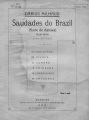
Magazines and Modernity in Brazil
Автор: Группа авторов
Год издания: 0000
The essays gathered in Magazines and Modernity in Brazil explore transnational topics such as architecture; cosmopolitanism and universalism; antisemitism, anti-war movements; visual artistic movements; advertising; anti-racism; avant-garde; class; consumer society; design; ethnicity and race; fascism and anti-fascism; intellectual elites; literature; modernity; publishing; translation, as well as book and periodical exchange, which is the main focus of this collection. Together, these essays propose a critique of traditional comparatist approaches, promoting instead the study of contact zones and intersections, highlighting the place of production and reception of cultural products, as well as the role of mediators. What guide these analyses of magazines are concepts such as connected and shared histories, which emphasize transnational interactions. Within the spectrum of global history, this collection is related to a recent body scholarship on cultural transfers, which opened a fertile field for new research based on the analysis of transnational movements not only of ideas but also of networks and magazines. Organized chronologically, the chapters explore a period from the mid-nineteenth century to the aftermath of World War II, always having key magazines as the focus of analysis. The authors deliberately move away from traditional comparative approaches, in which two or more nations are set as a parameter, leading to emphasize their similarities and differences in a rigid framework that does not take into account interactions and cross-pollination of cultures and ideas. Some of the keywords that appear here are transnational models, global, circulation, mediation, hybridity, mestizaje, as well as histories that are shared and connected. These keywords help the authors to analyse the formation and development of the participation of Brazil in the global, modern periodical print culture. However, it should be noted that the purpose of this book is not to suggest a supposed singularity of the Brazilian case. The contribution of this volume of essays is precisely the opposite of this, showing how modernity in Brazil, including what is conventionally called modernism, is a complex expression of transnational movements and cross-cultural exchanges.
 Brazilian Jiu-Jitsu: Theory and Technique
Автор: Gracie Renzo, Gracie Royler, Danaher John
Год издания:
During the last decade, the martial arts world has looked to innovative mixed martial arts competitions such as the Ultimate Fighting Championship to determine which fighting style is the best. These contests have repeatedly shown the grappling style of martial arts, headed by Brazilian jiu-jitsu, to dominate. The Brazilian jiu-jitsu style stems from the premise, garnered from analysis of actual street fights, that the outcome of any fight is decided on the ground. While most martial arts deal only with the initial punching and kicking stages of combat, Brazilian jiu-jitsu concentrates on ground combat. This guide shows how to use Brazilian jiu-jitsu to increase combat effectiveness. Photographs and step-by-step instructions show how to master the techniques used in this exciting new form of combat.
Renzo Gracie, a two-time world Abu Dhabi submission jiu-jitsu champion, two-time Brazilian national champion, World Combat champion, and Martial Arts Reality Superfight champion, teaches Brazilian jiu-jitsu at an elite martial arts academy. Royler Gracie has competed in the Black Belt ranks for 20 years, winning the world title four times and the Abu Dhabi world submission championship for two consecutive years. They live in New York City.