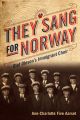
 They Sang for Norway
Автор: Ane-Charlotte Five Aarset
Год издания: 0000
They were brothers from Norway's "Red County." One was a guerrilla leader, the other a president of a singing association. One emigrated to America, the other stayed home to fight for Norwegian independence. Both had an impact on their nation's history. This is the story of the one who left.<br /><br />Olaf Martin Oleson was among the hundreds of thousands of Norwegians who emigrated to the United States during the nineteenth century. With strongly rooted connections to the homeland, Oleson settled in the Midwest and became a successful businessman, philanthropist, and politician. He also helped form influential organizations in his new land, including the Norwegian-American Historical Association and the Norwegian Singers' Association of America. With the choir group, Oleson shared songs of his native Norway throughout North America—while raising money to support the illegal army and new political party forming back home in the fight for liberation from Sweden.<br /><br />In <em>They Sang for Norway</em>, Ane-Charlotte Five Aarset tells the story of O. M. Oleson—her great-grand-uncle—and his contributions to the politics and culture of two nations. It is an immigrant's tale, an exploration of Norwegian-American life, and the story of music's importance to a community and people.
 Russia and Norway. Physical and Symbolic Borders
Автор: Сборник статей
Год издания:
The book is a collection of papers presented at the conference «Russia and Norway: Physical and Symbolic Borders» held in St Petersburg in April 2005 in connection with the opening of the exhibition «Norway – Russia. Neighbours through the ages». In the book different aspects of the history of the Norwegian-Russian border are covered by historians from Moscow, St Petersburg, Arkhangelsk, Copenhagen, Cambridge, Bergen and Tromso. The papers are diverse and refer to different chronological periods. One group of articles deals with problems connected with the medieval border treaties between Norway and Novgorodian Russia, others with the diplomatic history of the border convention of 1826, as well as its effect on ethnic minorities living in the border area. One author addresses the present-day delimitation controversy between Norway and Russia in the Barents Sea. Other articles deal with symbolic borders, for example, barriers in translating Russian literature into Norwegian, and borders between the two cultures, experienced by the Russian emigrants in Norway after the Russian Revolution. And finally, there are articles without explicit references to the concept of borders, where the authors investigate in more general terms different aspects of Norwegian-Russian relations.
 Zigzag Journeys in Northern Lands. The Rhine to the Arctic. A Summer Trip of the Zig-Zag Club Through Holland, Germany, Denmark, Norway, and Sweden

 Letters Written During a Short Residence in Sweden, Norway, and Denmark