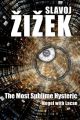
 The Most Sublime Hysteric. Hegel with Lacan
Автор: Slavoj Zi?ek
Год издания:
What do we know about Hegel? What do we know about Marx? What do we know about democracy and totalitarianism? Communism and psychoanalysis? What do we know that isn't a platitude that we've heard a thousand times – or a self-satisfied certainty? Through his brilliant reading of Hegel, Slavoj Zizek – one of the most provocative and widely-read thinkers of our time – upends our traditional understanding, dynamites every cliche and undermines every conviction in order to clear the ground for new ways of answering these questions. When Lacan described Hegel as the ‘most sublime hysteric’, he was referring to the way that the hysteric asks questions because he experiences his own desire as if it were the Other's desire. In the dialectical process, the question asked of the Other is resolved through a reflexive turn in which the question begins to function as its own answer. We had made Hegel into the theorist of abstraction and reaction, but by reading Hegel with Lacan, Zizek unveils a Hegel of the concrete and of revolution – his own, and the one to come. This early and dazzlingly original work by Zizek offers a unique insight into the ideas which have since become hallmarks of his mature thought. It will be of great interest to anyone interested in critical theory, philosophy and contemporary social thought.
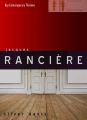 Jacques Ranciere
Автор: Oliver Davis
Год издания:
This book is a critical introduction to contemporary French philosopher Jacques Ranciere. It is the first introduction in any language to cover all of his major work and offers an accessible presentation and searching evaluation of his significant contributions to the fields of politics, pedagogy, history, literature, film theory and aesthetics. This book traces the emergence of Ranciere’s thought over the last forty-five years and situates it in the diverse intellectual contexts in which it intervenes. Beginning with his egalitarian critique of his former teacher Louis Althusser, the book tracks the subsequent elaboration of Ranciere’s highly original conception of equality. This approach reveals that a grasp of his early archival and historiographical work is vital for a full understanding both of his later politics and his ongoing investigation of art and aesthetics. Along the way, this book explains and analyses key terms in Ranciere’s very distinctive philosophical lexicon, including the ‘police’ order, ‘disagreement’, ‘political subjectivation’, ‘literarity’, the ‘part which has no part’, the ‘regimes of art’ and ‘the distribution of the sensory’. This book argues that Ranciere’s work sets a new standard in contestatory critique and concludes by reflecting on the philosophical and policy implications of his singular project.