Создание международной фирмы. Location
Автор: Майкл Соснин
Год издания:
Обычно я начинаю рассказывать о месте в середине книги, а это только вторая часть, поэтому должен быть весомый повод изменить традицию. «Любая информационная структуризация – самая серьезная практика для любого менеджера любого ранга», – сказал один из моих профессоров в Оксфорде. Скажем, я должен выпустить одну точку информации в неделю – книгу, эссе, статью в блоге, интервью в аудио-/видео-форматах – ну, любой.
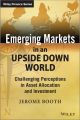 Emerging Markets in an Upside Down World. Challenging Perceptions in Asset Allocation and Investment
Автор: Jerome Booth
Год издания:
The world is upside down. The emerging market countries are more important than many investors realise. They have been catching up with the West over the past few decades. Greater market freedom has spread since the end of the Cold War, and with it institutional changes which have further assisted emerging economies in becoming more productive, flexible, and resilient. The Western financial crisis from 2008 has quickened the pace of the relative rise of emerging markets – their relative economic power, and with it political power, but also their financial power as savers, investors and creditors. Emerging Markets in an Upside Down World – Challenging Perceptions in Asset Allocation and Investment argues that finance theory has misunderstood risk and that this has led to poor investment decisions; and that emerging markets constitute a good example of why traditional finance theory is faulty. The book accurately describes the complex and changing global environment currently facing the investor and asset allocator. It raises many questions often bypassed because of the use of simplifying assumptions and models. The narrative builds towards a checklist of issues and questions for the asset allocator and investor and then to a discussion of a variety of regulatory and policy issues. Aimed at institutional and retail investors as well as economics, finance, business and international relations students, Emerging Markets in an Upside Down World covers many complex ideas, but is written to be accessible to the non-expert.
 Pensionize Your Nest Egg. How to Use Product Allocation to Create a Guaranteed Income for Life
Автор: Moshe Milevsky A.
Год издания:
Guarantee your retirement income with a DIY pension Pensionize Your Nest Egg describes how adding the new approach of «product allocation» to the tried-and-true asset allocation approach can help protect you from the risk of outliving your savings, while maximizing your income in retirement. This book demonstrates that it isn't the investor with the most money who necessarily has the best retirement income plan. Instead, it's the investor who owns the right type of investment and insurance products, and uses product allocation to allocate the right amounts, at the right time, to each product category. This revised second edition is expanded to include investors throughout the English-speaking world and updated to reflect current economic realities. Readers will learn how to distinguish between the various types of retirement income products available today, including life annuities and variable annuities with living income benefits, and how to evaluate the features that are most important to meet their personal retirement goals. Evaluate the impacts of longevity, inflation, and sequence of returns risk on your retirement income portfolio Make sense of the bewildering array of today's retirement income products Measure and maximize your Retirement Sustainability Quotient Learn how your product allocation choices can help maximize current income or financial legacy – and how to select the approach that's right for you Walk through detailed case studies to explore how to pensionize your nest egg using the new product allocation approach Whether you do it yourself or work with a financial advisor, Pensionize Your Nest Egg gives you a step-by-step plan to create a guaranteed retirement income for life.
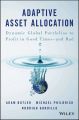 Adaptive Asset Allocation. Dynamic Global Portfolios to Profit in Good Times - and Bad
Автор: Adam Butler
Год издания:
Build an agile, responsive portfolio with a new approach to global asset allocation Adaptive Asset Allocation is a no-nonsense how-to guide for dynamic portfolio management. Written by the team behind Gestaltu.com, this book walks you through a uniquely objective and unbiased investment philosophy and provides clear guidelines for execution. From foundational concepts and timing to forecasting and portfolio optimization, this book shares insightful perspective on portfolio adaptation that can improve any investment strategy. Accessible explanations of both classical and contemporary research support the methodologies presented, bolstered by the authors' own capstone case study showing the direct impact of this approach on the individual investor. Financial advisors are competing in an increasingly commoditized environment, with the added burden of two substantial bear markets in the last 15 years. This book presents a framework that addresses the major challenges both advisors and investors face, emphasizing the importance of an agile, globally-diversified portfolio. Drill down to the most important concepts in wealth management Optimize portfolio performance with careful timing of savings and withdrawals Forecast returns 80% more accurately than assuming long-term averages Adopt an investment framework for stability, growth, and maximum income An optimized portfolio must be structured in a way that allows quick response to changes in asset class risks and relationships, and the flexibility to continually adapt to market changes. To execute such an ambitious strategy, it is essential to have a strong grasp of foundational wealth management concepts, a reliable system of forecasting, and a clear understanding of the merits of individual investment methods. Adaptive Asset Allocation provides critical background information alongside a streamlined framework for improving portfolio performance.
 A Practitioner's Guide to Asset Allocation
Автор: William Kinlaw
Год издания:
Since the formalization of asset allocation in 1952 with the publication of Portfolio Selection by Harry Markowitz, there have been great strides made to enhance the application of this groundbreaking theory. However, progress has been uneven. It has been punctuated with instances of misleading research, which has contributed to the stubborn persistence of certain fallacies about asset allocation. A Practitioner's Guide to Asset Allocation fills a void in the literature by offering a hands-on resource that describes the many important innovations that address key challenges to asset allocation and dispels common fallacies about asset allocation. The authors cover the fundamentals of asset allocation, including a discussion of the attributes that qualify a group of securities as an asset class and a detailed description of the conventional application of mean-variance analysis to asset allocation.. The authors review a number of common fallacies about asset allocation and dispel these misconceptions with logic or hard evidence. The fallacies debunked include such notions as: asset allocation determines more than 90% of investment performance; time diversifies risk; optimization is hypersensitive to estimation error; factors provide greater diversification than assets and are more effective at reducing noise; and that equally weighted portfolios perform more reliably out of sample than optimized portfolios. A Practitioner's Guide to Asset Allocation also explores the innovations that address key challenges to asset allocation and presents an alternative optimization procedure to address the idea that some investors have complex preferences and returns may not be elliptically distributed. Among the challenges highlighted, the authors explain how to overcome inefficiencies that result from constraints by expanding the optimization objective function to incorporate absolute and relative goals simultaneously. The text also explores the challenge of currency risk, describes how to use shadow assets and liabilities to unify liquidity with expected return and risk, and shows how to evaluate alternative asset mixes by assessing exposure to loss throughout the investment horizon based on regime-dependent risk. This practical text contains an illustrative example of asset allocation which is used to demonstrate the impact of the innovations described throughout the book. In addition, the book includes supplemental material that summarizes the key takeaways and includes information on relevant statistical and theoretical concepts, as well as a comprehensive glossary of terms.
Чтобы скачать книгу, отключите блокировку рекламы. Спасибо!